

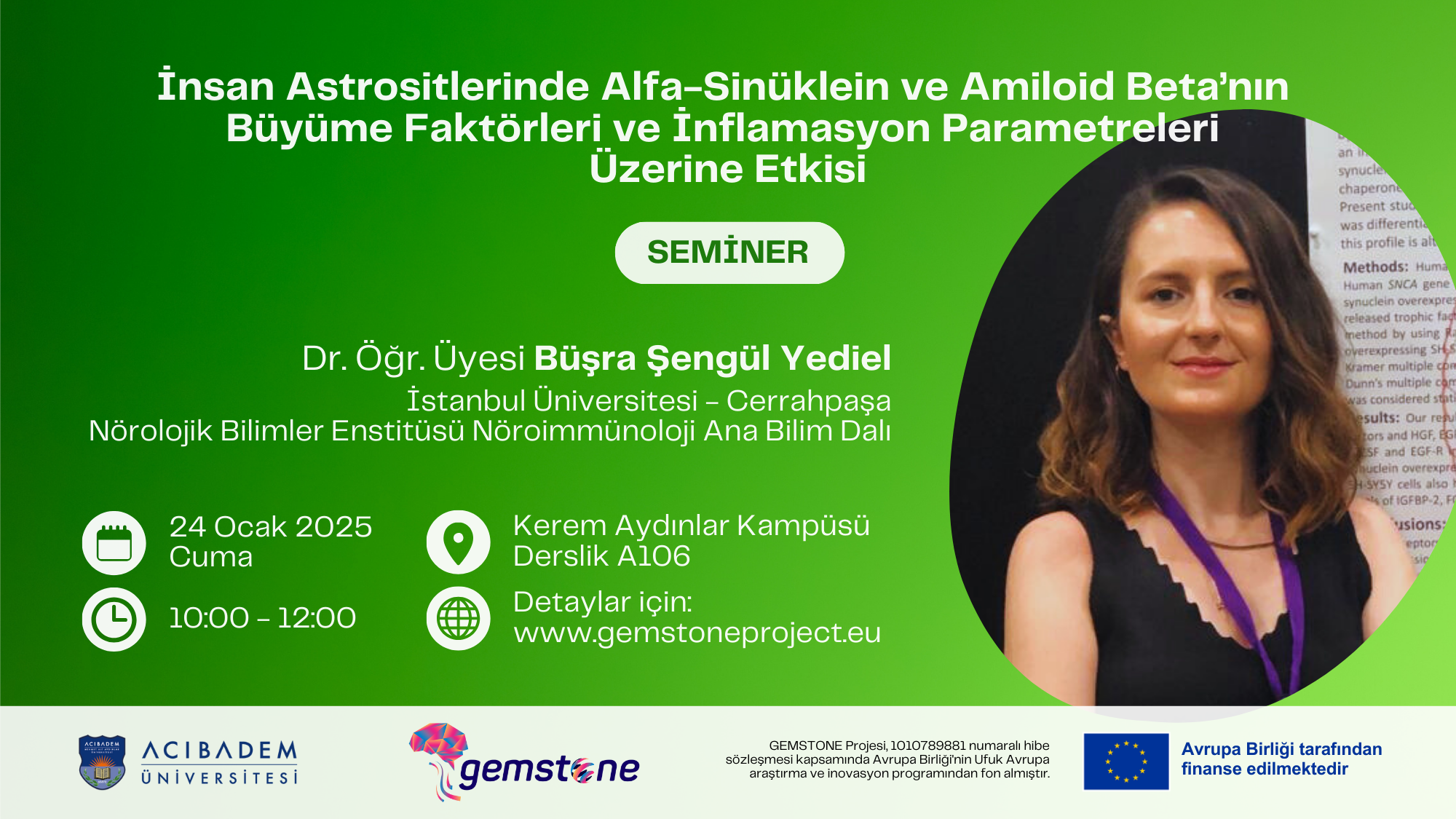
We are delighted to invite you to an engaging seminar exploring the effects of alpha-synuclein and amyloid beta on human astrocytes. The seminar will feature Dr. Busra Sengul Yediel, a distinguished academic from Istanbul University - Cerrahpasa. Dr. Sengul Yediel will share her cutting-edge research on the effects of alpha-synuclein and amyloid beta on growth factors and inflammatory parameters in human astrocytes.
The Horizon Europe-funded GEMSTONE Project and Acibadem Mehmet Ali Aydinlar University’s (ACU) Neuroscience PhD Programme are delighted to announce an upcoming seminar by Asst. Prof. Busra Sengul Yediel from the Neuroimmunology Department at the Institute of Neurological Sciences, Istanbul University - Cerrahpasa. This insightful event will explore cutting-edge research on the role of astrocytes in neurodegenerative diseases.
Seminar details
Title: Effects of Alpha-Synuclein and Amyloid Beta on Growth Factors and Inflammatory Parameters in Human Astrocytes
Date: Friday, 24 January 2025
Time: 10:00 – 12:00 Istanbul time
Location: Room A106, ACU Kerem Aydinlar Campus, Kayisdagi Cad. 32, Atasehir, Istanbul
About the speaker
Asst. Prof. Busra Sengul Yediel completed her undergraduate education at Istanbul University, Faculty of Science, Department of Biology in 2014. She completed her Master’s degree at Istanbul University, Institute of Health Sciences, Cerrahpasa Faculty of Medicine, Department of Medical Biology in 2017 and received the title of PhD in 2023. In the same year, she started working as a postdoctoral researcher at Istanbul University - Cerrahpasa, Institute of Neurological Sciences, Department of Neuroscience. She is currently working as an assistant professor at the Department of Neuroimmunology of the same institute. She has studies in the field of molecular neuroimmunology including primary human astrocyte culture, neuron-astrocyte co-culture, cell-based assay, and RNA/protein analyses (immunoprecipitation).
Seminar abstract
In neurodegenerative diseases, specific neuron types and glial cells undergo degeneration, leading to the appearance of specific disease symptoms. Neurodegenerative diseases in the central nervous system (CNS) are also highly effective on cells that support neuron life. Astrocytes are support cells in the central nervous system. Together with the other neuroglial cells, these cells produce neurotransmitters, hormones, trophic and immune factors, and participate in synaptic functions in various stages of development. On the other hand, they become reactive in response to almost all pathological conditions that occur in the brain, such as ischemia, infection, and neurodegenerative diseases. Reactive astrocyte gliosis and microglia activation are among the common pathological mechanisms of these diseases. Reactive astrogliosis protects CNS cells through several mechanisms, including the release of protective factors. In Alzheimer’s disease (AD), amyloid beta (Aβ) is suggested to induce a pathological pathway that leads to neurodegeneration and dementia. Parkinson’s disease (PD) and dementia with Lewy bodies (DLB) are among α-synucleinopathies, which are neurodegenerative disorders characterized by an abnormal accumulation of α-synuclein protein that is insoluble in neurons or glial cells. Based on this information, in this study, AD-like pathology was induced by applying Aβ1-42, and PD-like pathology was induced by the overexpression of α-synuclein in human astrocyte cultures. The study was designed to determine the response of human astrocytes to these pathologies in terms of growth factors and inflammatory response and the profile that is different from that of a healthy astrocyte population. Changes in the levels of intracellular and secreted growth factors and inflammatory proteins were detected. The data showed that Aβ1-42 treatment and α-synuclein overexpression in astrocytes significantly altered untreated astrocyte culture profiles and determined which inflammatory mediators and growth factors were predominantly triggered. In this seminar, Dr. Sengul Yediel will present the data of their related study.
Why attend?
This seminar presents a unique opportunity to learn about cutting-edge research in the field of neuroscience and molecular neuroimmunology. It aligns with GEMSTONE’s mission to foster knowledge transfer, bilateral scientific exchange, and capacity building in gene engineering technologies and neuroscience. Researchers, students, and professionals in the fields of neuroscience, biology, and medicine are encouraged to attend.
Join us for this insightful session and expand your understanding of the effects of alpha-synuclein and amyloid beta on human astrocytes and the role of astrocytes in neurodegenerative diseases. We look forward to welcoming you to this enriching academic event.
About GEMSTONE
The GEMSTONE Project (“Genetically engineering Experimental Models: enhancement of Scientific and Technological excellence and innOvation potential to study NEurodevelopmental diseases”) is a Horizon Europe-funded initiative led by Acibadem Mehmet Ali Aydınlar University (ACU). The project aims to enhance ACU’s research and innovation capacity in gene engineering technologies and neuroscience, focusing on neurodevelopmental brain disorders such as Parkinson’s disease and epilepsy. GEMSTONE fosters collaboration with Lund University and ICONS to boost ACU’s global competitiveness and visibility in neuroscience.
For more information about the project updates and upcoming events, please subscribe to our website on the homepage.